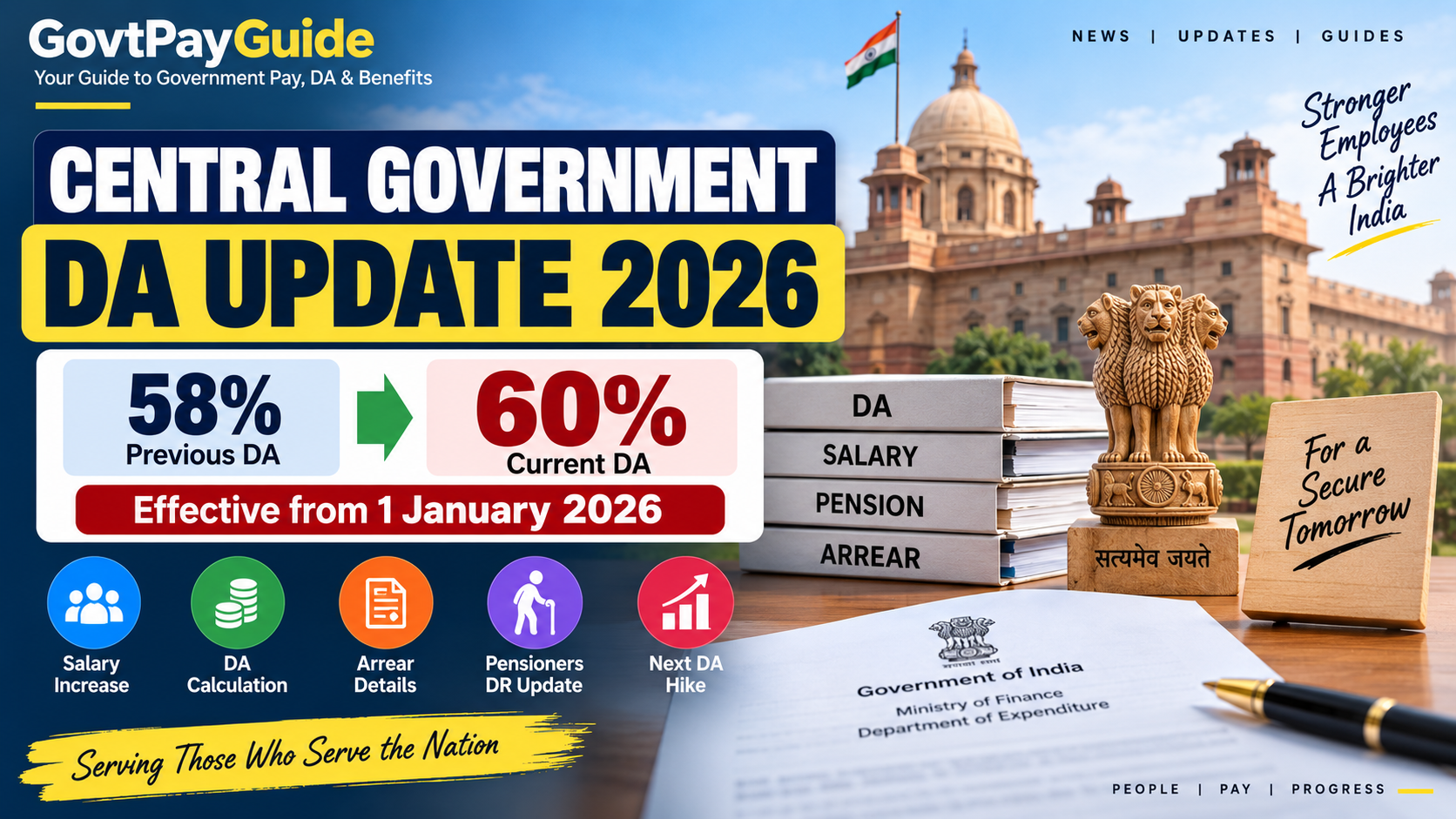
Central Government DA Latest Update 2026: What Is the Current DA Rate?
Central Government employees and pensioners received an important Dearness Allowance (DA) and Dearness Relief (DR) update in 2026.
The Union Cabinet approved an additional 2 percentage point increase in Dearness Allowance for Central Government employees and Dearness Relief for pensioners.
As a result, DA/DR increased from:
58% to 60%
The revised rate is effective from:
1 January 2026
Therefore, the latest officially verified Dearness Allowance rate for eligible Central Government employees is:
60% of Basic Pay
For eligible Central Government pensioners, Dearness Relief is:
60% of Basic Pension
In this article, we explain the current DA rate, salary increase, arrears, pensioners' DR, calculation examples and what is officially known about the next DA revision.
Central Government DA 2026 – Key Details
Current DA Rate: 60%
Previous DA Rate: 58%
Increase: 2 percentage points
Effective Date: 1 January 2026
Applicable To: Eligible Central Government Employees
Pensioners' DR: 60%
Pay Structure: 7th Central Pay Commission
Cabinet Approval: 18 April 2026
DA Increased from 58% to 60% – How Much Will Salary Increase?
An increase from 58% to 60% does not mean an employee's salary has increased by 60%.
Employees were already receiving DA at 58% of Basic Pay. The revised rate is 60%.
Therefore, the additional increase is:
2% of Basic Pay
The formula is:
Additional Monthly DA = Basic Pay × 2 ÷ 100
For example, if an employee's Basic Pay is ₹30,000:
Old DA @ 58% = ₹17,400
New DA @ 60% = ₹18,000
Additional Monthly DA = ₹600
How to Calculate DA at 60%
The basic formula is:
DA = Basic Pay × 60 ÷ 100
For example:
Basic Pay = ₹40,000
DA @ 60% = ₹24,000
Basic Pay + DA = ₹64,000
However, this is not the employee's complete gross or take-home salary.
HRA, Transport Allowance, other applicable allowances, NPS contribution, CGHS contribution, income tax and other deductions may also affect the final salary.
DA Calculation for ₹18,000 Basic Pay
Suppose the Basic Pay is ₹18,000.
New DA @ 60%:
₹18,000 × 60 ÷ 100
= ₹10,800
Old DA @ 58%:
₹18,000 × 58 ÷ 100
= ₹10,440
Additional Monthly DA:
₹10,800 − ₹10,440
= ₹360
Therefore, an employee with ₹18,000 Basic Pay gets an additional ₹360 per month in DA due to the 2 percentage point increase.
DA Calculation for ₹25,000 Basic Pay
Basic Pay = ₹25,000
Old DA @ 58% = ₹14,500
New DA @ 60% = ₹15,000
Monthly Increase = ₹500
Basic Pay + New DA = ₹40,000
DA Calculation for ₹30,000 Basic Pay
Basic Pay = ₹30,000
Old DA @ 58% = ₹17,400
New DA @ 60% = ₹18,000
Monthly Increase = ₹600
Basic Pay + New DA = ₹48,000
DA Calculation for ₹40,000 Basic Pay
Basic Pay = ₹40,000
Old DA @ 58% = ₹23,200
New DA @ 60% = ₹24,000
Monthly Increase = ₹800
Basic Pay + New DA = ₹64,000
DA Calculation for ₹50,000 Basic Pay
Basic Pay = ₹50,000
Old DA @ 58% = ₹29,000
New DA @ 60% = ₹30,000
Monthly Increase = ₹1,000
Basic Pay + New DA = ₹80,000
DA Calculation for ₹60,000 Basic Pay
Basic Pay = ₹60,000
Old DA @ 58% = ₹34,800
New DA @ 60% = ₹36,000
Monthly Increase = ₹1,200
Basic Pay + New DA = ₹96,000
DA Calculation for ₹80,000 Basic Pay
Basic Pay = ₹80,000
Old DA @ 58% = ₹46,400
New DA @ 60% = ₹48,000
Monthly Increase = ₹1,600
Basic Pay + New DA = ₹1,28,000
DA Calculation for ₹1,00,000 Basic Pay
Basic Pay = ₹1,00,000
Old DA @ 58% = ₹58,000
New DA @ 60% = ₹60,000
Monthly Increase = ₹2,000
Basic Pay + New DA = ₹1,60,000
Central Government DA 60% Calculation Table
Basic Pay | DA @ 58% | DA @ 60% | Monthly Increase
₹18,000 | ₹10,440 | ₹10,800 | ₹360
₹25,000 | ₹14,500 | ₹15,000 | ₹500
₹30,000 | ₹17,400 | ₹18,000 | ₹600
₹40,000 | ₹23,200 | ₹24,000 | ₹800
₹50,000 | ₹29,000 | ₹30,000 | ₹1,000
₹60,000 | ₹34,800 | ₹36,000 | ₹1,200
₹80,000 | ₹46,400 | ₹48,000 | ₹1,600
₹1,00,000 | ₹58,000 | ₹60,000 | ₹2,000
The above table is intended to explain the DA component only.
Actual gross and take-home salary will depend on the employee's Pay Level, HRA, Transport Allowance, other allowances and applicable deductions.
How Much Will Annual Income Increase?
Since the DA revision adds 2% of Basic Pay, the annual increase in the DA component can be estimated using:
Additional Monthly DA × 12
For example, if Basic Pay is ₹50,000:
Additional Monthly DA = ₹1,000
Estimated increase for 12 months:
₹1,000 × 12 = ₹12,000
This represents only the additional DA component.
The actual amount received during a financial year can vary depending on the effective date, payment date, arrears and payroll processing.
What Is the DR Rate for Central Government Pensioners?
Dearness Relief for eligible Central Government pensioners has also increased from 58% to 60%.
The revised DR is effective from:
1 January 2026
The formula is:
DR = Basic Pension × 60 ÷ 100
For example:
Basic Pension = ₹20,000
DR @ 60% = ₹12,000
Basic Pension + DR = ₹32,000
Other applicable pension components or deductions are not included in this example.
Example for ₹30,000 Basic Pension
Basic Pension = ₹30,000
Old DR @ 58% = ₹17,400
New DR @ 60% = ₹18,000
Monthly Increase = ₹600
Basic Pension + New DR = ₹48,000
How Many Employees and Pensioners Will Benefit?
According to the official Government announcement, the DA/DR revision is expected to benefit approximately:
50.46 lakh Central Government employees
and
68.27 lakh pensioners
The combined financial implication of the increase is estimated at approximately:
₹6,791.24 crore per year
The revision is based on the accepted formula recommended by the 7th Central Pay Commission.
Will Employees Receive DA Arrears from January 2026?
The revised DA/DR rate of 60% is effective from 1 January 2026.
Therefore, where the revised rate was implemented after the effective date, the difference between the old and revised rates for the applicable period may result in arrears.
The difference is:
60% − 58% = 2 percentage points
For example, if Basic Pay is ₹50,000:
Monthly difference = ₹50,000 × 2%
= ₹1,000
If an illustrative three-month difference is considered:
₹1,000 × 3
= ₹3,000
This is only an example.
The actual arrear amount and payment period should be verified from the applicable Government order and the employee's payroll records.
Does a Higher DA Affect HRA?
DA and HRA are different salary components, but the DA level can affect the applicable HRA rate under the 7th CPC HRA structure.
Under the Central Government HRA rules, HRA rates are revised when DA crosses specified thresholds.
After DA crossed the 50% threshold, the applicable HRA rates moved to the higher prescribed slab.
The actual HRA depends on the employee's city classification and Basic Pay.
Employees should therefore calculate HRA separately instead of treating DA and HRA as the same component.
You can also use the GovtPayGuide HRA Calculator to estimate HRA based on Basic Pay and city category.
Has 60% DA Been Merged with Basic Pay?
No.
A DA rate of 60% does not automatically mean that DA has been merged with Basic Pay.
Under the current structure:
Basic Pay is a separate component
and
DA is an allowance calculated on Basic Pay
For example:
Basic Pay = ₹40,000
DA @ 60% = ₹24,000
Basic Pay + DA = ₹64,000
This does not mean the employee's new Basic Pay has become ₹64,000.
The Basic Pay remains ₹40,000, while ₹24,000 is the DA component.
How Is Central Government DA Determined?
Dearness Allowance revisions for Central Government employees are linked to the accepted formula based on the recommendations of the 7th Central Pay Commission.
The All India Consumer Price Index for Industrial Workers, commonly known as AICPI-IW, plays an important role in determining DA movements.
DA/DR revisions are generally considered with January and July as reference points.
However, there is an important difference between:
Calculated or expected DA
and
Officially approved DA
A projected rate based on AICPI-IW data should not be treated as the final applicable rate until the Government formally approves and notifies the revision.
What Will Be the Next DA Hike from July 2026?
This is one of the biggest questions among Central Government employees.
Various calculations may estimate the possible DA rate from July 2026 based on AICPI-IW data.
However, an expected rate and an officially approved rate are not the same thing.
At the time of this article update, GovtPayGuide has not treated any projected July 2026 DA percentage as a confirmed Government rate without a final Cabinet decision and corresponding official order.
Therefore, employees should avoid treating speculative percentages circulating online as final.
Once the Government officially approves the next DA/DR revision, the new rate, effective date and salary impact can be calculated accordingly.
What Happens to DA When the 8th Pay Commission Is Implemented?
The 8th Central Pay Commission is a separate process from the current DA revision under the existing 7th CPC pay structure.
Future recommendations may affect areas such as:
- Revised Basic Pay
- Fitment methodology
- Allowance structure
- Pension revision
- Treatment of Dearness Allowance
However, employees should not assume an exact fitment factor, revised Basic Pay or DA merger until the recommendations are finalized and accepted by the Government.
The current 60% DA should therefore be understood within the existing applicable pay structure.
How Can Employees Check Their Own DA?
Check the Basic Pay shown on your latest salary slip.
Then use:
Basic Pay × 60 ÷ 100
For example:
Basic Pay = ₹45,000
DA @ 60%:
₹45,000 × 60%
= ₹27,000
Basic Pay + DA:
₹45,000 + ₹27,000
= ₹72,000
Remember that ₹72,000 is not necessarily the employee's final take-home salary.
Other allowances and deductions must also be considered.
Does the Entire DA Increase Become Take-Home Salary?
Not necessarily.
An increase in DA can affect gross salary, but the full increase may not always appear as an identical increase in net take-home pay.
Applicable deductions may include:
- NPS contribution
- Income Tax
- CGHS contribution
- Other deductions
- Recoveries
Other salary components may also be affected depending on the applicable service rules.
Therefore, Gross Salary and Net Take-Home Salary should be calculated separately.
Frequently Asked Questions
What is the current DA rate for Central Government employees in 2026?
The latest officially verified DA rate covered in this update is 60% of Basic Pay, effective from 1 January 2026.
What was the previous DA rate?
The previous rate was 58%.
How much did DA increase in January 2026?
DA increased by 2 percentage points, from 58% to 60%.
How much DA will an employee with ₹50,000 Basic Pay receive?
At 60%:
₹50,000 × 60% = ₹30,000
How much additional DA will an employee with ₹50,000 Basic Pay receive?
The increase from 58% to 60% is 2% of Basic Pay.
₹50,000 × 2% = ₹1,000 per month
This calculation covers only the additional DA component.
What is the DR rate for Central Government pensioners?
Eligible Central Government pensioners covered by the revision receive 60% DR on Basic Pension, effective from 1 January 2026.
Has the July 2026 DA rate been officially announced?
A projected DA percentage should not be treated as official until the Government approves and notifies the revision.
GovtPayGuide will treat only a verified Government announcement/order as the confirmed new rate.
Has 60% DA been merged with Basic Pay?
No. DA remains a separate allowance calculated on Basic Pay under the current structure.
Official Sources
Press Information Bureau, Government of India:
https://www.pib.gov.in/PressReleasePage.aspx?PRID=2253244
Department of Expenditure, Ministry of Finance:
Department of Expenditure – What's New / Archive:
https://doe.gov.in/archive/whats-new
Employees and pensioners should always refer to the latest Government of India orders for final eligibility, payment and arrear details.
Conclusion
The latest officially verified Central Government DA/DR revision covered in this article increased the rate from 58% to 60%.
The increase is:
2 percentage points
and is effective from:
1 January 2026
For an employee with a Basic Pay of ₹50,000, DA at 60% is ₹30,000, which represents an additional ₹1,000 per month compared with the previous 58% rate.
Eligible Central Government pensioners also receive DR at 60% of Basic Pension under the revision.
Employees should be careful about claims regarding the next DA revision. A projected rate based on AICPI-IW calculations should not be treated as final until an official Government decision is issued.
For the latest applicable rate, the official Cabinet decision and Department of Expenditure orders should always be treated as the primary reference.
Disclaimer
GovtPayGuide is an independent informational website and is not affiliated with the Government of India, Ministry of Finance or any other Government department.
This article is intended to explain publicly available Government information in simple language. Employees and pensioners should verify salary, DA, DR, arrears and individual entitlement from the latest official orders issued by the Department of Expenditure, PIB and their concerned Government office.