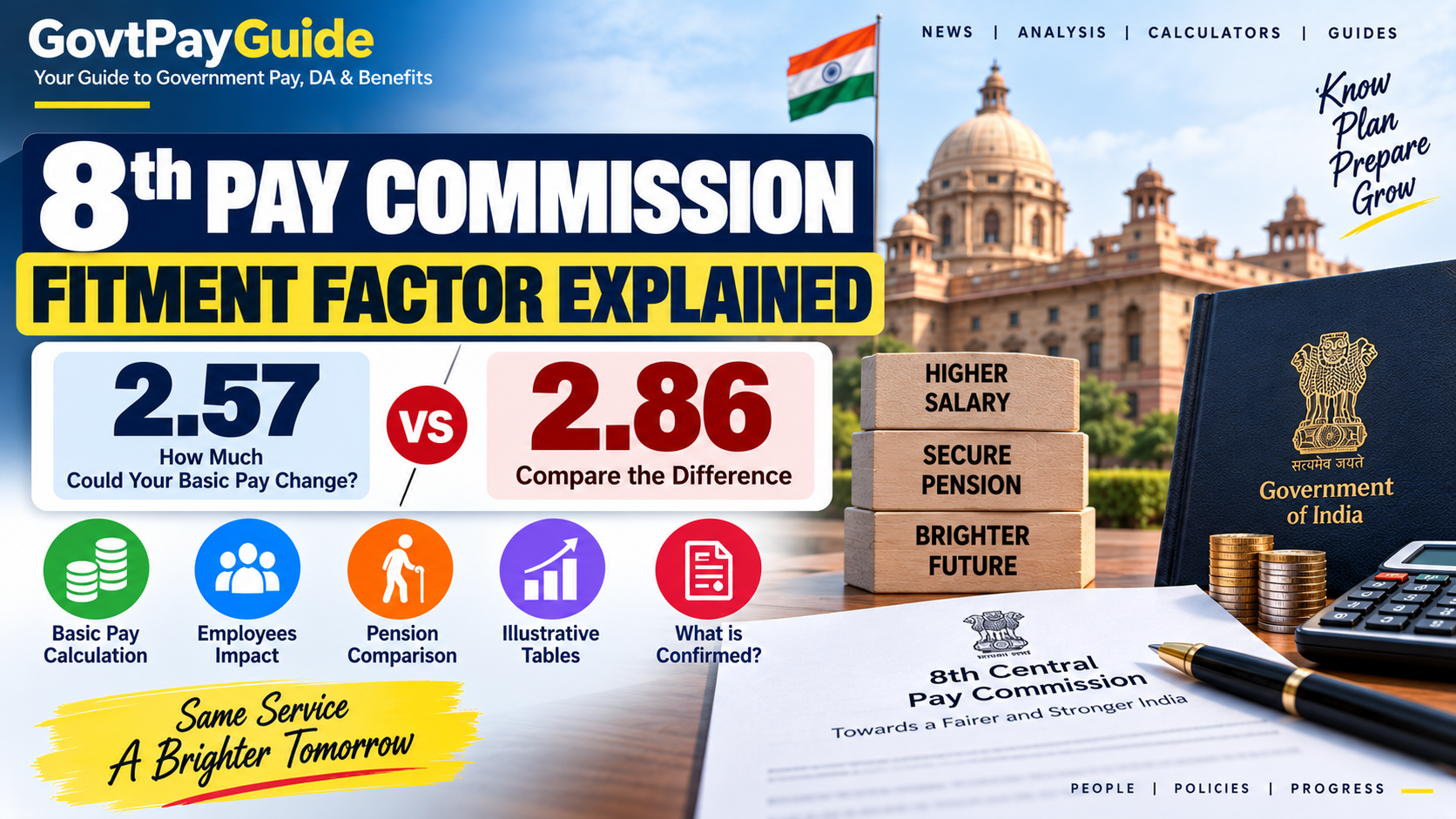
8th Pay Commission Fitment Factor: Why Is Everyone Talking About It?
The fitment factor has become one of the most discussed topics among Central Government employees since the 8th Central Pay Commission process began.
Employees naturally want to know:
What will be the new minimum Basic Pay?
Will the fitment factor be 2.57, 2.86 or something else?
How much could an existing Basic Pay change?
And will the same multiplier apply to pensioners?
Before looking at any calculation, one fact is more important than everything else:
No final 8th Pay Commission fitment factor has been officially announced as of this update.
Therefore, numbers such as 2.57 and 2.86 should not be presented as confirmed 8th CPC rates.
In this GovtPayGuide analysis, we use these figures only as mathematical examples to explain how different multipliers would affect Basic Pay.
What Is a Fitment Factor?
A fitment factor is essentially a multiplier that can be used when moving from an existing pay structure to a revised one.
A simplified example is:
Existing Basic Pay × Fitment Factor = Illustrative Revised Basic Pay
Suppose an employee has an existing Basic Pay of ₹30,000.
If a hypothetical factor of 2.57 is used:
₹30,000 × 2.57 = ₹77,100
If a hypothetical factor of 2.86 is used:
₹30,000 × 2.86 = ₹85,800
The difference between the two results is:
₹85,800 − ₹77,100 = ₹8,700
However, this does not mean either ₹77,100 or ₹85,800 is the employee's officially revised 8th CPC Basic Pay.
These are only mathematical illustrations.
Is 2.57 the Official 8th Pay Commission Fitment Factor?
No.
2.57 is widely recognised because it was associated with the transition under the 7th Central Pay Commission.
That historical connection does not automatically mean the 8th CPC will use the same factor.
The 8th Central Pay Commission will make its recommendations after examining the issues covered by its Terms of Reference and the information and representations placed before it.
Until an official recommendation and subsequent Government decision are available, 2.57 should not be labelled as the official 8th CPC factor.
Is 2.86 Confirmed?
No.
A 2.86 multiplier is frequently discussed in online salary projections and employee-related discussions.
But discussion, demand, expectation and final Government approval are four different things.
For GovtPayGuide, a fitment factor will be treated as confirmed only when it is supported by an official Pay Commission recommendation or Government decision.
Therefore:
2.86 is not being presented here as a confirmed 8th CPC fitment factor.
Why Compare 2.57 and 2.86 Then?
The comparison is useful for one reason:
It shows how sensitive revised Basic Pay can be to the multiplier used.
For example, on ₹18,000:
At 2.57:
₹18,000 × 2.57 = ₹46,260
At 2.86:
₹18,000 × 2.86 = ₹51,480
Difference:
₹5,220
This helps employees understand the mathematics without claiming that either figure will become the final Government-approved salary.
2.57 vs 2.86 Basic Pay Comparison
Existing Basic Pay | At 2.57 | At 2.86 | Difference
₹18,000 | ₹46,260 | ₹51,480 | ₹5,220
₹20,000 | ₹51,400 | ₹57,200 | ₹5,800
₹25,000 | ₹64,250 | ₹71,500 | ₹7,250
₹30,000 | ₹77,100 | ₹85,800 | ₹8,700
₹40,000 | ₹1,02,800 | ₹1,14,400 | ₹11,600
₹50,000 | ₹1,28,500 | ₹1,43,000 | ₹14,500
₹60,000 | ₹1,54,200 | ₹1,71,600 | ₹17,400
₹80,000 | ₹2,05,600 | ₹2,28,800 | ₹23,200
₹1,00,000 | ₹2,57,000 | ₹2,86,000 | ₹29,000
₹1,50,000 | ₹3,85,500 | ₹4,29,000 | ₹43,500
₹2,00,000 | ₹5,14,000 | ₹5,72,000 | ₹58,000
Important: Every figure in this table is an illustrative mathematical result. This is not an official 8th CPC Pay Matrix or salary forecast.
What Would Happen to the ₹18,000 Minimum Basic Pay?
Under the existing 7th CPC pay structure, ₹18,000 is the minimum Basic Pay at Level 1.
This makes ₹18,000 one of the most commonly used numbers in 8th CPC projections.
Mathematically:
₹18,000 × 2.57 = ₹46,260
₹18,000 × 2.86 = ₹51,480
This is why figures around ₹46,260 and ₹51,480 frequently appear in discussions about the 8th Pay Commission.
But multiplication alone cannot establish the new minimum Basic Pay.
The Commission could recommend a different multiplier, methodology, rounding mechanism or pay structure.
Therefore:
₹46,260 is not a confirmed minimum Basic Pay.
₹51,480 is also not a confirmed minimum Basic Pay.
What This Means for Employees
The difference between a hypothetical 2.57 and 2.86 factor becomes larger as Basic Pay increases.
For ₹18,000 Basic Pay, the difference between the two calculations is ₹5,220.
For ₹50,000, it becomes ₹14,500.
For ₹1,00,000, it becomes ₹29,000.
But employees should not use these differences to plan loans, investments or major expenses as if they were guaranteed salary increases.
The final revised pay will depend on the Commission's recommendations and the Government's decision.
Fitment Factor Does Not Equal Take-Home Salary
This is another major source of confusion.
Even if a future fitment methodology produces a revised Basic Pay, that figure will not automatically equal monthly take-home salary.
A salary structure can contain several components, including:
- Basic Pay
- Dearness Allowance
- House Rent Allowance
- Transport Allowance
- Other applicable allowances
- NPS contributions
- Income Tax
- CGHS and other deductions
Therefore:
Revised Basic Pay ≠ Final Take-Home Salary
A proper salary calculation will only be possible after the revised pay and allowance rules are officially known.
Could the Final Fitment Factor Be Different from Both 2.57 and 2.86?
Yes.
This is precisely why treating either figure as confirmed is risky.
The Commission is not required to choose between two numbers circulating online.
It can examine compensation structures, economic conditions, pension costs, Government finances and other matters within its Terms of Reference before making recommendations.
The final methodology could therefore differ from popular online assumptions.
Current Official Status of the 8th CPC
The Government of India formally constituted the 8th Central Pay Commission in November 2025.
The Commission subsequently sought structured inputs from stakeholders during 2026.
It invited representations, memoranda and suggestions from Central Government employees, pensioners, service associations, Government departments and other eligible stakeholders.
The memorandum submission window ultimately closed on 15 June 2026.
The Commission has also continued interactions and visits as part of its consultation process.
This tells us that the official process is active.
It does not tell us that a final fitment factor has already been decided.
Why Employee Demands and Official Decisions Must Be Separated
Suppose an employee organisation demands a particular fitment factor.
That means:
An organisation has proposed or demanded that figure.
It does not mean:
The Pay Commission has recommended it.
And even a Pay Commission recommendation must subsequently go through the Government's decision-making process.
A useful way to understand the sequence is:
Employee/Association Demand
↓
8th CPC Examination
↓
8th CPC Recommendation
↓
Government Consideration
↓
Final Accepted/Notified Structure
Skipping these stages is one of the main reasons misleading salary figures spread online.
What About Pensioners?
Pensioners are also closely watching the 8th CPC because retirement benefits form part of the broader Pay Commission framework.
But the same caution applies to pension calculations.
A simple multiplication can illustrate a scenario, but it cannot predict the final pension revision methodology.
Suppose an existing Basic Pension is ₹20,000.
At hypothetical 2.57:
₹20,000 × 2.57 = ₹51,400
At hypothetical 2.86:
₹20,000 × 2.86 = ₹57,200
Difference:
₹5,800
These are educational calculations only.
They should not be described as officially revised pensions.
Illustrative Pension Comparison
Existing Basic Pension | At 2.57 | At 2.86
₹10,000 | ₹25,700 | ₹28,600
₹15,000 | ₹38,550 | ₹42,900
₹20,000 | ₹51,400 | ₹57,200
₹25,000 | ₹64,250 | ₹71,500
₹30,000 | ₹77,100 | ₹85,800
₹40,000 | ₹1,02,800 | ₹1,14,400
₹50,000 | ₹1,28,500 | ₹1,43,000
Again, this is not an official pension table.
The final pension methodology may not be a simple multiplication of existing Basic Pension.
What Could Happen to DA?
Under the existing 7th CPC structure, Central Government employees receive DA separately on Basic Pay.
A new Pay Commission generally involves transition to a revised pay structure.
However, employees should not take the current DA percentage, add it to an assumed fitment factor and call the result the final 8th CPC salary.
The treatment of DA during the transition will depend on the final recommendations and Government implementation orders.
Until those details are known, combining speculative fitment factors with current DA can produce misleading salary estimates.
Why a Higher Fitment Factor Does Not Tell the Whole Story
It is tempting to assume:
Higher fitment factor = proportionately higher real income
But actual compensation is more complicated.
The final financial impact can depend on:
- Revised Basic Pay
- Pay Matrix design
- Allowance rules
- DA treatment
- HRA structure
- Pension rules
- Deductions
- Tax impact
- Level-wise placement
Therefore, employees should evaluate the complete revised pay structure once it becomes available rather than focusing only on one multiplier.
Could the Pay Matrix Also Change?
Yes, the pay structure itself is an important part of the Pay Commission exercise.
The current 7th CPC uses a Pay Matrix with different Pay Levels and cells.
Whether the 8th CPC retains, modifies or replaces aspects of that structure will become clear only after official recommendations are available.
As of this update, GovtPayGuide is not publishing any unofficial chart as the “final 8th CPC Pay Matrix.”
When Will We Know the Actual Fitment Factor?
The Cabinet-approved Terms of Reference require the 8th Central Pay Commission to make its recommendations within 18 months from the date of its constitution.
The Commission may also consider interim reports if necessary.
The actual fitment methodology will become reliable for salary calculation only when relevant recommendations and Government decisions are officially available.
Until then, employees should treat online fitment calculations as scenarios rather than entitlements.
Is 1 January 2026 the Effective Date?
The Government's official background note on the Terms of Reference stated that Pay Commission recommendations are usually implemented after a ten-year interval and, going by that trend, the effect of the 8th CPC recommendations would normally be expected from 1 January 2026.
That statement is important, but it should be interpreted carefully.
It does not mean revised salaries based on a final 8th CPC fitment factor have already been paid from January 2026.
The eventual effective date, implementation date and arrear treatment will depend on the final Government decision.
Could 8th CPC Arrears Be Paid Later?
Potentially, arrears could arise if the Government eventually gives the revised structure effect from a date earlier than the actual implementation/payment date.
However, an exact arrear amount cannot currently be calculated reliably because several essential inputs are not final, including:
- Revised Basic Pay
- Fitment methodology
- Final effective date
- Allowance treatment
- Implementation rules
Any calculator claiming to provide an exact final 8th CPC arrear today should therefore be treated cautiously.
Confirmed vs Speculation
Officially Confirmed
- The 8th Central Pay Commission has been constituted.
- Its Terms of Reference have been approved.
- The Commission is conducting its official work.
- Stakeholder questionnaires and memorandum exercises were conducted during 2026.
- The memorandum submission deadline was extended to 15 June 2026.
- The Commission has been holding stakeholder interactions and visits.
- It is required to make recommendations within 18 months from its constitution.
Not Confirmed as Final
- 2.57 fitment factor
- 2.86 fitment factor
- Any other final fitment factor
- ₹51,480 as confirmed minimum Basic Pay
- Final 8th CPC Pay Matrix
- Exact revised salary for every Pay Level
- Final revised pension amount
- Exact arrear amount
- Date on which revised salary will actually be credited
This distinction should be kept in mind whenever reading an 8th Pay Commission salary claim.
GovtPayGuide Calculation Rule
For our 8th CPC coverage, GovtPayGuide follows a simple rule:
Official figure → Present as confirmed with source
Employee/association demand → Clearly label as a demand
Mathematical scenario → Clearly label as illustrative
Media/online speculation → Never present as Government-approved fact
This approach helps employees understand possible outcomes without confusing projections with entitlements.
Frequently Asked Questions
What is the official 8th Pay Commission fitment factor?
No final fitment factor has been officially announced as of this update.
Is 2.86 confirmed for the 8th Pay Commission?
No. GovtPayGuide does not treat 2.86 as a confirmed Government-approved fitment factor.
Is 2.57 confirmed?
No. Its relevance to the previous pay revision does not make it the automatically applicable 8th CPC factor.
What would ₹18,000 become at 2.57?
Mathematically:
₹18,000 × 2.57 = ₹46,260
This is an illustrative figure, not confirmed revised Basic Pay.
What would ₹18,000 become at 2.86?
Mathematically:
₹18,000 × 2.86 = ₹51,480
Again, this is not an officially confirmed minimum Basic Pay.
Which is better, 2.57 or 2.86?
Mathematically, 2.86 produces a higher figure.
But employees cannot choose the fitment factor. The relevant methodology will depend on the Commission's recommendations and Government decision.
Will pensioners get the same fitment factor?
The final pension revision methodology has not been officially confirmed. It should not be assumed that a simple salary multiplier will automatically apply identically to every pension case.
Can I calculate my exact 8th CPC salary now?
No. You can compare hypothetical scenarios, but an exact revised salary requires the official fitment methodology, revised Pay Matrix and implementation rules.
Official Sources
8th Central Pay Commission:
8th CPC Latest Updates:
https://8cpc.gov.in/whats-new/
8th CPC Memorandum Submission:
https://8cpc.gov.in/8cpc-memorandum-submission/
Press Information Bureau – Terms of Reference:
https://www.pib.gov.in/PressReleasePage.aspx?PRID=2183290
Employees and pensioners should use official Government and 8th CPC publications as the primary source for final fitment, salary and pension decisions.
Conclusion
The fitment factor will be one of the most important numbers in determining how the 8th Central Pay Commission affects employees, but the final figure has not yet been officially announced.
Comparing 2.57 and 2.86 is useful for understanding the mathematics.
For an existing ₹18,000 Basic Pay:
At 2.57 = ₹46,260
At 2.86 = ₹51,480
But neither calculation is a confirmed 8th CPC minimum Basic Pay.
The same caution applies to pension calculations, Pay Matrix projections and arrear estimates.
The safest approach is to separate official decisions from employee demands and illustrative scenarios.
Once the Commission's relevant recommendations and the Government's implementation decision become available, GovtPayGuide can replace these hypothetical comparisons with official level-wise salary and pension calculations.
Disclaimer
GovtPayGuide is an independent informational website and is not affiliated with the Government of India, Ministry of Finance or the 8th Central Pay Commission.
The 2.57 and 2.86 calculations in this article are mathematical illustrations only. They are not predictions, recommendations or officially approved fitment factors.
Always verify final salary, pension, Pay Matrix, fitment factor and implementation details from official Government orders.